Royal Air Force News Friday, December 26, 2025 P19
Heroes of AAF and RAFVR Features
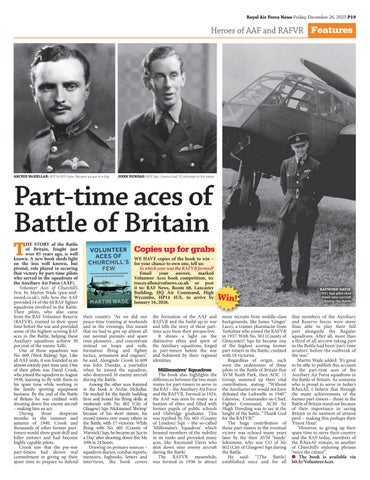
ARCHIE McKELLAR: 602 & 605 Sqns. Became an ace in a day
JOHN DUNDAS: 609 Sqn. Journo had 10 victories to his name
Part-time aces of Battle of Britain
T
HE STORY of the Battle of Britain, fought just over 85 years ago, is well known. A new book sheds light on the less well known, but pivotal, role played in securing that victory by part-time pilots who served in the squadrons of the Auxiliary Air Force (AAF). Volunteer Aces of Churchill’s Few, by Martin Wade (pen-andsword.co.uk), tells how the AAF provided 14 of the 60 RAF fighter squadrons involved in the Battle. Their pilots, who also came from the RAF Volunteer Reserve (RAFVR), trained in their spare time before the war and provided some of the highest-scoring RAF aces in the Battle, helping these Auxiliary squadrons achieve 30 per cent of the enemy ‘kills’. One of those squadrons was No. 609 (West Riding) Sqn. Like all AAF units, it was founded as an almost entirely part-time unit. One of their pilots was David Crook, who joined the squadron in August 1938, learning to fly with them in his spare time while working in the family sporting equipment business. By the end of the Battle of Britain he was credited with shooting down five enemy aircraft – making him an ace. During those desperate months in the summer and autumn of 1940, Crook and thousands of other former parttimers would show great skill and killer instinct and had become highly capable pilots. Crook saw that the pre-war part-timers had shown real commitment in giving up their spare time to prepare to defend
Copies up for grabs WE HAVE copies of the book to win – for your chance to own one, tell us: In which year was the RAFVR formed? Email your answer, marked Volunteer Aces book competition, to: tracey.allen@rafnews.co.uk or post it to: RAF News,, Room 68, Lancaster Building, HQ Air Command, High Wycombe, HP14 4UE, to arrive by January 16, 2026. their country. “As we did our peace-time training at weekends and in the evenings, this meant that we had to give up almost all our normal pursuits and spare time pleasures…and concentrate instead on loops and rolls, formation flying and fighter tactics, armament and engines,” he said. Alongside Crook in 609 was John Dundas, a journalist when he joined the squadron, who destroyed 10 enemy aircraft during the Battle. Among the other aces featured in the book is Archie McKellar. He worked for the family building firm and honed his flying skills at weekends with No. 602 (City of Glasgow) Sqn. Nicknamed ‘Shrimp’ because of his short stature, his record towers over many others in the Battle, with 17 victories. While flying with No. 605 (County of Warwick) Sqn, he became an ‘Ace in a Day’ after shooting down five Me 109s in 24 hours. Drawing on primary sources – squadron diaries, combat reports, memoirs, logbooks, letters and interviews, the book covers
the formation of the AAF and RAFVR and the build-up to war and tells the story of these parttime aces from their perspective. It shines a light on the distinctive ethos and spirit of the Auxiliary squadrons, forged as part-timers before the war and bolstered by their regional identities. Millionaires’ Squadron The book also highlights the differences between the two main routes for part-timers to serve in the RAF – the Auxiliary Air Force and the RAFVR. Formed in 1924, the AAF was seen by many as a bastion of elites and filled with former pupils of public schools and Oxbridge graduates. This was typified by No. 601 (County of London) Sqn – the so-called ‘Millionaire’s Squadron’ which boasted members of the nobility in its ranks and provided many aces, like Raymond Davis who shot down nine enemy aircraft during the Battle. The RAFVR meanwhile, was formed in 1936 to attract
Win! more recruits from middle-class backgrounds, like James ‘Ginger’ Lacey, a trainee pharmacist from Yorkshire who joined the RAFVR in 1937. With No. 501 (County of Gloucester) Sqn he became one of the highest scoring former part-timers in the Battle, credited with 18 victories. Regardless of origin, such were the endeavours of these pilots in the Battle of Britain that AVM Keith Park, then AOC 11 Group, summed up their vital contribution, stating: “Without the Auxiliaries we would not have defeated the Luftwaffe in 1940”. Likewise, Commander-in-Chief, Fighter Command, ACM Sir Hugh Dowding was to say at the height of the battle, “Thank God for the RAFVR!” The huge contribution of those part-timers to the eventual victory was echoed many years later by the then AVM ‘Sandy’ Johnstone, who was CO of No 602 (City of Glasgow) Sqn during the Battle. He said: “[The Battle] established once and for all
RAYMOND DAVIS: 601 Sqn pilot shot down nine aircraft during the Battle
that members of the Auxiliary and Reserve forces were more than able to play their full part alongside the Regular squadrons. After all, more than a third of all aircrew taking part in the Battle had been ‘part-time aviators’ before the outbreak of the war.” Martin Wade added: ‘It’s great to be able to publish this account of the part-time aces of the Auxiliary Air Force squadrons in the Battle of Britain. As someone who is proud to serve in today’s RAuxAF, I believe that through the many achievements of the former part-timers – those in the Battle of Britain stand out because of their importance in saving Britain in its moment of utmost peril – making this perhaps their ‘Finest Hour’. “However, in giving up their spare time to serve their country and the RAF today, members of the RAuxAF remain, in another of Churchill’s enduring phrases ‘twice the citizen’”. ● The book is available via bit.ly/VolunteerAces.